
Why Smart Miners Are Watching Difficulty More Than Bitcoin Price
When Bitcoin makes headlines, most people immediately look at the price.
Did Bitcoin go up? Did it go down? Is a new all-time high coming?
For miners, however, the price is only part of the story.
Many experienced ASIC miners spend just as much time watching Bitcoin mining difficulty as they do watching Bitcoin itself. In some cases, difficulty can have a bigger impact on profitability than price movement.
That may sound surprising, but once you understand how mining works, it becomes clear why smart miners are paying close attention to difficulty adjustments.
At AsicProfit, miners can compare ASIC performance, calculate profitability, and estimate ROI using current mining conditions instead of relying on price alone.
The Difference Between Bitcoin Price and Mining Difficulty
Bitcoin price affects how much mined Bitcoin is worth.
Mining difficulty affects how hard it is to earn that Bitcoin.
A higher Bitcoin price can increase revenue, but if difficulty rises at the same time, miners may not feel the full benefit.
Difficulty increases when more hashpower joins the network. As competition grows, miners must work harder to earn the same rewards.
This means two things can happen at once:
- Bitcoin price rises
- Miner profitability stays flat
This is one reason why many miners watch difficulty as closely as they watch the market.
Why Difficulty Has Become More Important in 2026
Bitcoin’s mining industry has become far more competitive.
Large mining farms continue expanding, newer ASIC miners are becoming more efficient, and global hashrate remains near historic highs.
As more machines join the network, difficulty naturally increases.
Recent mining reports have shown Bitcoin difficulty remaining near record levels while miner revenue has experienced periods of decline despite strong Bitcoin pricing.
For miners, this creates a challenging environment where efficiency matters more than ever.
External market data:
https://coinmarketcap.com/currencies/bitcoin/
A Simple Example
Imagine two situations.
Scenario A
- Bitcoin price rises 10%
- Mining difficulty rises 15%
Scenario B
- Bitcoin price stays flat
- Mining difficulty falls 8%
Many miners would actually prefer Scenario B.
Why?
Because a lower difficulty adjustment directly improves their share of network rewards.
Price gains are helpful, but miners only benefit if they can actually earn enough Bitcoin in the first place.
How Difficulty Affects Different ASIC Miners
Not all miners respond to difficulty changes in the same way.
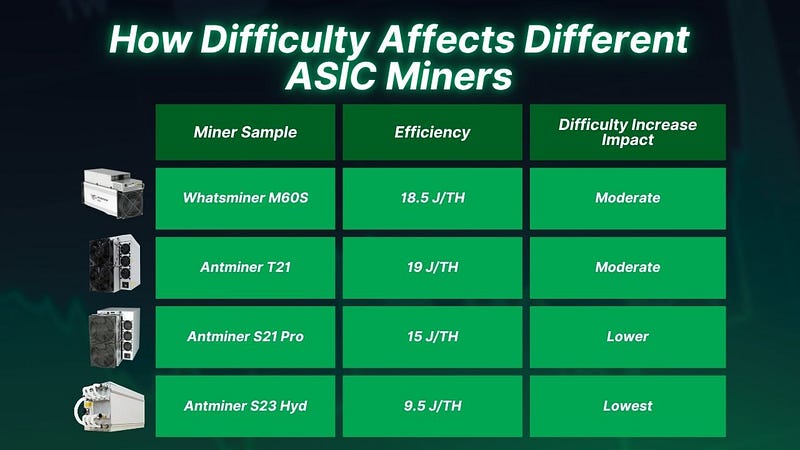
More efficient miners can usually absorb difficulty increases more effectively because they consume less electricity for every terahash produced.
Older or less efficient miners often feel pressure first when difficulty rises.
Compare ASIC miners here:
Electricity Cost Makes Difficulty Even More Important
Difficulty becomes even more critical when electricity costs are high.
Consider a miner operating at:
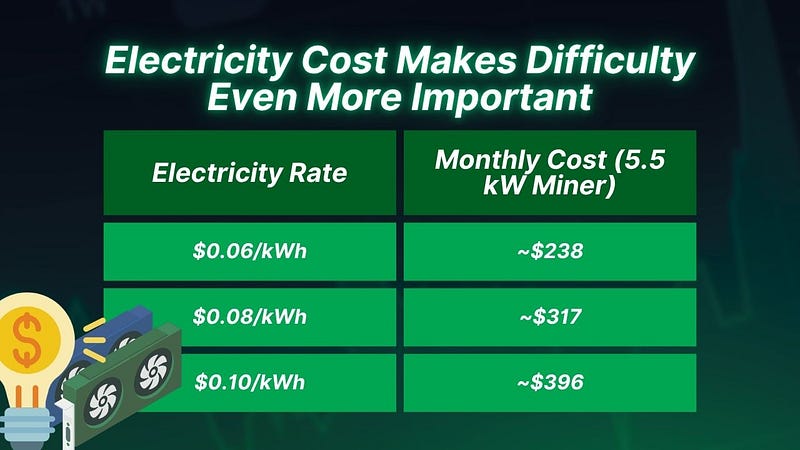
When difficulty rises, miners earn less Bitcoin for the same power consumption.
That means every kilowatt-hour becomes more important.
A miner paying $0.10/kWh may see profitability disappear much faster than a miner operating at $0.06/kWh.
This is why many professional miners constantly monitor both electricity rates and network difficulty.
Calculate your mining costs here:
https://asicprofit.com/calculator
Smart Miners Watch Hashrate Too
Difficulty does not move by itself.
It follows hashrate.
When network hashrate increases, difficulty usually follows. When hashrate drops significantly, a lower difficulty adjustment may eventually occur.
Many experienced miners watch:
- Network hashrate
- Difficulty projections
- Block production speed
- Hashprice
- ASIC efficiency trends
These indicators often provide a better picture of mining profitability than Bitcoin price alone.
Difficulty Can Create Opportunities
Not every difficulty change is bad.
A difficulty decrease can temporarily improve mining conditions.
When weaker miners shut down because of rising costs, the remaining miners may benefit from reduced competition.
This is one reason why some experienced operators view difficulty drops as opportunities rather than warnings.
If their hardware remains efficient and electricity costs are manageable, lower difficulty can improve profitability without requiring any additional investment.
The Shift Toward Data-Driven Mining
The mining industry is becoming more analytical.
A few years ago, many miners focused primarily on Bitcoin price.
Today, successful miners often focus on:
- ASIC efficiency
- Electricity costs
- Difficulty trends
- Uptime
- Cooling performance
- ROI calculations
The conversation is shifting from speculation to operational performance.
That is a healthy sign for the long-term mining industry.
Conclusion
Bitcoin price will always matter.
But for ASIC miners, difficulty often tells a more important story.
A rising Bitcoin price can look exciting, but if difficulty climbs even faster, profitability may not improve much at all.
That is why experienced miners continue watching difficulty adjustments, hashrate trends, and operational efficiency alongside market prices.
The miners who understand these numbers usually make better long-term decisions.
Before buying hardware, scaling your operation, or changing your mining strategy, use AsicProfit to compare ASIC miners, calculate electricity costs, and estimate ROI.
Calculate your ROI now at https://asicprofit.com
#AsicProfit #BitcoinMining #ASICMining #Asicminer
Stay Connected
🎥 YouTube