
Bitcoin mining generates a huge amount of data every day.
Hashrate changes. Difficulty adjusts. Revenue fluctuates. New ASIC miners launch. Electricity costs shift. Bitcoin price moves.
The challenge for miners is not finding information. The challenge is knowing which information actually matters.
Many miners spend hours watching Bitcoin price charts while ignoring the mining signals that often have a greater impact on profitability.
Today’s report focuses on the key signals ASIC miners should be reading right now and what those signals may reveal about the state of the mining market.
At AsicProfit, miners can analyze profitability, compare ASIC hardware, and calculate ROI using current market conditions.
Signal #1: Network Hashrate
Hashrate represents the total computing power securing the Bitcoin network.
When hashrate rises, it usually means more miners are joining the network or existing miners are expanding operations.
When hashrate falls, it often indicates that some miners are shutting down because operating costs have become too high.
Many miners view hashrate as a health indicator for the entire mining ecosystem.
Why It Matters
A rising hashrate generally signals:
- Growing competition
- More efficient hardware entering the market
- Greater network security
A falling hashrate can indicate:
- Miner capitulation
- Higher operational stress
- Reduced profitability for weaker operators
For miners, hashrate helps provide context for future difficulty adjustments.
Signal #2: Mining Difficulty
Difficulty determines how hard it is to find new Bitcoin blocks.
Unlike price, difficulty directly affects how much Bitcoin miners can earn from the same amount of hashpower.
Many experienced miners watch difficulty projections daily because they often provide a clearer picture of future profitability.
Difficulty and Miner Revenue
Imagine two scenarios:
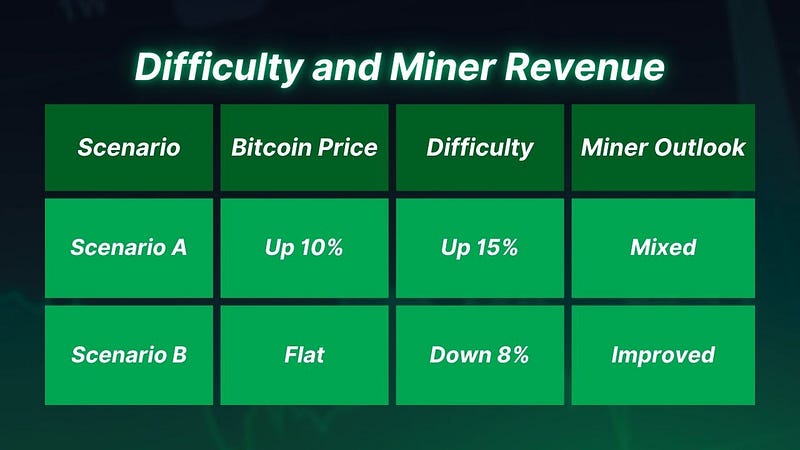
Many miners would prefer Scenario B because lower difficulty can increase their share of rewards.
This is one reason why professional miners often track difficulty as closely as Bitcoin price.
Signal #3: ASIC Efficiency Trends
Another important signal is ASIC efficiency.
The mining industry continues moving toward lower J/TH ratings as manufacturers release newer hardware.
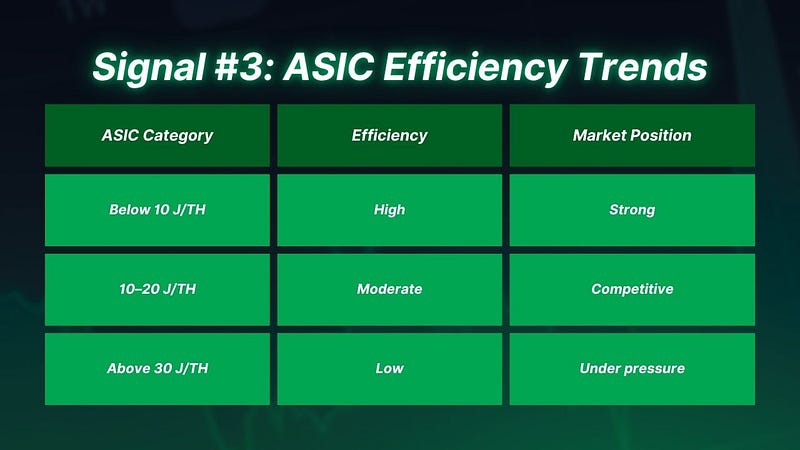
Efficiency remains one of the strongest indicators of long-term survivability.
When mining conditions become difficult, efficient machines usually stay online while older hardware often struggles.
Compare ASIC miners here:
Signal #4: Hashprice
Hashprice measures how much revenue miners can earn per unit of hashpower.
Think of it as a quick profitability gauge for the entire industry.
A rising hashprice generally means:
- Better miner revenue
- Stronger operating margins
- More expansion opportunities
A falling hashprice often signals:
- Margin compression
- Greater efficiency requirements
- Increased pressure on older miners
Hashprice often reacts faster than many other mining metrics, making it a useful signal to monitor.
Signal #5: Electricity Cost Trends
Electricity continues to be one of the most important profitability signals.
For example, a 5.5 kW ASIC miner running continuously costs dramatically different amounts depending on electricity rate.
At $0.06/kWh, monthly operating costs are around $238.
At $0.10/kWh, those costs rise to roughly $396.
That difference can exceed $1,900 annually for a single miner.
As mining margins tighten, electricity cost becomes increasingly important.
Calculate your mining costs here:
https://asicprofit.com/calculator
Signal #6: Miner Revenue
Miner revenue combines several important factors:
- Bitcoin price
- Difficulty
- Transaction fees
- Hashrate
- Block production
Revenue alone does not tell the whole story, but it provides a useful snapshot of current mining conditions.
When revenue declines while difficulty rises, miners often begin evaluating hardware efficiency more aggressively.
When revenue improves while difficulty remains stable, miners may expand operations.
Putting the Signals Together
The most successful miners rarely focus on a single metric.
Instead, they watch how signals interact.
For example:
- Rising hashrate + rising difficulty = stronger competition
- Falling hashrate + falling difficulty = possible relief for miners
- Stable price + lower difficulty = potential profitability improvement
- Higher price + higher difficulty = mixed outcome
Mining profitability is usually the result of multiple signals moving together.
Daily Miner Checklist
Before making mining decisions today, review:
- Network hashrate.
- Difficulty trend
- ASIC efficiency
- Hashprice
- Electricity rate
- Miner uptime
- ROI projections
A few minutes spent reviewing these signals can help prevent expensive mistakes.
Conclusion
Bitcoin mining is becoming more data-driven every year.
The miners succeeding today are not necessarily the ones with the biggest operations. They are often the ones who understand the signals behind profitability.
Hashrate, difficulty, efficiency, electricity costs, and revenue all provide valuable information about the market.
The better you understand these signals, the better your mining decisions become.
Before upgrading hardware, changing strategy, or scaling operations, use AsicProfit to compare miners, estimate costs, and calculate ROI.
Calculate your ROI now at https://asicprofit.com
#AsicProfit #BitcoinMining #ASICMining #Asicminer
Stay Connected
🎥 YouTube